

Emerald Ash Borer Is Still a Serious Problem for Ash Trees
If you have an ash tree in your yard, knowing the signs of emerald ash borer can help you catch a problem before the tree becomes a hazard. This invasive insect has killed millions of ash trees across Ohio and continues to leave dying and hazardous trees behind in neighborhoods, parks, and commercial properties alike.
The problem is that emerald ash borer damage can be easy to miss at first. By the time the signs are obvious from the ground, the tree may already be seriously stressed or declining. For homeowners in Medina, Wadsworth, Cleveland, Akron, Canton, and surrounding Northeast Ohio communities, knowing what to look for can help you act before the tree becomes a danger.
What Is Emerald Ash Borer?
A Small Insect That Causes Big Damage
Emerald ash borer, often called EAB, is a metallic green beetle that attacks ash trees. The adult beetles might get the attention, but the real damage happens beneath the bark, where EAB larvae feed and disrupt the tree’s ability to move water and nutrients.
As the infestation progresses, the tree begins to decline from the top down. Branches die, the canopy thins, and the tree can eventually become brittle, unstable, and unsafe.
Why Ash Trees Become Dangerous
Dead or dying ash trees can be especially risky because they often become brittle as they decline. Large limbs may break without much warning, and a dead ash tree near a home, driveway, sidewalk, garage, or road can become a serious property hazard.
Ohio State University’s Buckeye Yard & Garden Line has noted that severely infested ash trees can die within a year, and dead ash trees combined with wind can be a dangerous combination.
Learn more: Ohio State University BYGL, Watch Your ASH!

1. Thinning Leaves or Dieback in the Crown
Look at the Top of the Tree First
One of the most common signs of emerald ash borer is thinning in the upper canopy. The top of the ash tree may look sparse or bare compared to previous years. You may notice dead branches near the top while lower parts still have some leaves.
This happens because the insect damage disrupts the tree’s internal system. As the tree struggles to move water and nutrients, the upper canopy often shows stress first.
Warning Signs in the Canopy
Watch for:
- Bare branches during the growing season
- Sparse leaves near the top of the tree
- Dead limbs in the upper crown
- One section of the tree declining faster than the rest
- More sunlight coming through the canopy than usual
A thin canopy in an ash tree with other warning signs present should be taken seriously, as it could be EAB.
2. D-Shaped Exit Holes in the Bark
A Small Detail With Meaning
Adult emerald ash borers leave small D-shaped exit holes when they emerge from the tree. These holes are tiny, so they can be hard to spot from the ground. Still, they are one of the more recognizable signs of EAB activity.
The holes are usually about 1/8 inch wide and may appear on the trunk or larger branches.
Where to Look
You may find exit holes:
- On the trunk
- On larger limbs
- Near areas where bark is splitting
- Around declining sections of the tree
- In areas with heavy woodpecker activity
Do not rely on exit holes alone. They can be difficult to see, especially on larger trees. Most homeowners notice other symptoms first.
3. Woodpecker Damage on the Trunk or Branches
Woodpeckers Are Likely to Find the Problem First
Woodpeckers feed on insects beneath the bark, so increased woodpecker activity can be a clue that something is happening inside. On ash trees, this often shows up as light-colored patches where birds have stripped away outer bark while searching for larvae.
This is sometimes called bark flecking or blonding because the damaged areas may look lighter than the surrounding bark.
What Woodpecker Damage May Look Like
Common signs include:
- Light patches on the trunk or branches
- Stripped or flaking outer bark
- Repeated woodpecker activity on the same tree
- Small bark chips around the base
- More visible damage higher in the canopy
Woodpecker damage isn’t proof of emerald ash borer, but on an ash tree in Northeast Ohio, it is a warning sign worth checking out.

4. Bark Splitting or S-Shaped Galleries
Damage Beneath the Bark
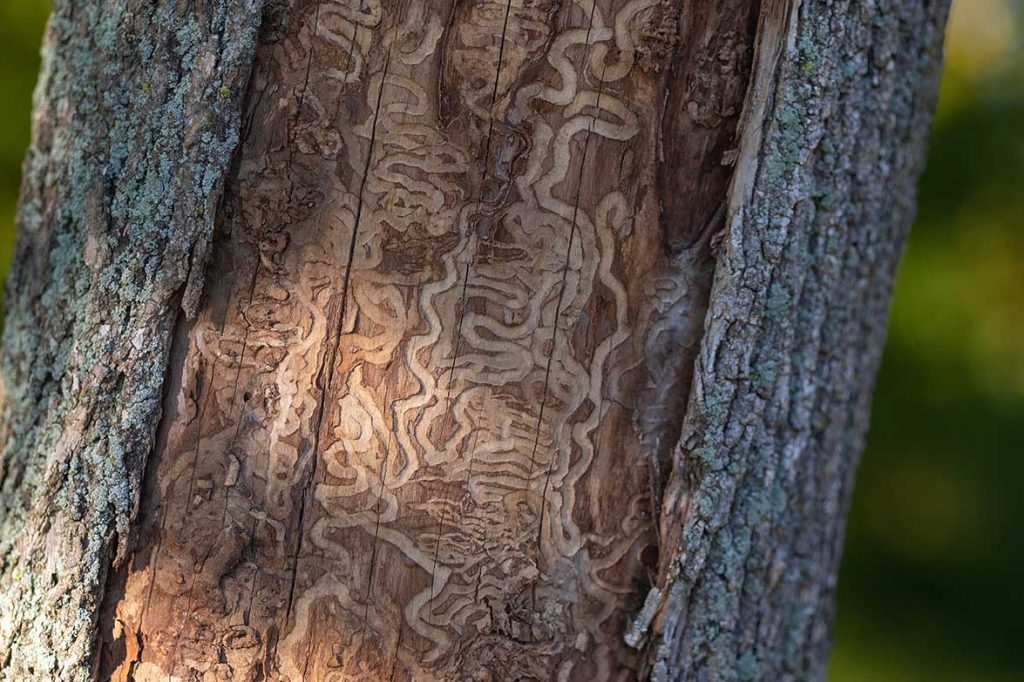
As emerald ash borer larvae feed, they create winding galleries beneath the bark. These galleries interrupt the tree’s ability to move water and nutrients. Sometimes, as the bark splits or loosens, those S-shaped patterns become visible.
You should not peel bark off a healthy tree just to check for EAB, but if bark is already splitting or falling away, visible galleries can be a strong sign of infestation.
Signs Around the Bark
Look for:
- Vertical splits in the bark
- Bark loosening or falling off
- Winding tunnels beneath exposed bark
- Fresh cracks paired with canopy decline
- Damaged areas where birds have been feeding
Sadly, by the time galleries are easy to see, it may be too late.
5. New Shoots Growing From the Trunk or Base
A Stress Response From the Tree
Ash trees under stress may push out new shoots from the trunk, lower limbs, or base of the tree. These shoots are sometimes called suckers or epicormic sprouts. They can make the tree look like it is trying to recover, but they often point to a larger problem.
When the upper canopy is failing, the tree may send growth from lower areas in an attempt to survive.
When New Growth Is a Concern
Pay attention if you notice:
- Shoots growing from the base of the tree
- Small branches sprouting from the trunk
- New lower growth paired with a thinning crown
- Heavy sprouting after several seasons of decline
- Lower growth while upper limbs continue dying
This type of growth is a sign of stress, especially when combined with other EAB signs and symptoms.

6. Dead Limbs or Branches Dropping
When an Infestation Becomes a Safety Issue
A declining ash tree may begin dropping dead limbs. At first, this may look like normal storm cleanup or seasonal branch loss. Over time, the pattern can become more serious.
If your ash tree is dropping large limbs, has dead branches over the driveway, or is declining near a structure, it may be time to discuss removal. Dead ash trees can become hazardous quickly, especially during thunderstorms, high winds, snow, or ice.
Call Expert Tree Solutions if You See These Hazards
You should call for professional help if:
- Large dead limbs are hanging overhead
- Branches are falling during ordinary weather
- Dead limbs are over your house, garage, or driveway
- The trunk is cracked or splitting
- The tree is leaning or appears unstable
- The ash tree is mostly dead or no longer leafing out
Learn more about our Tree Removal Services
See when you may need Emergency Tree Service
Can an Ash Tree With Emerald Ash Borer Be Saved?
It Depends on the Condition of the Tree
Some ash trees may be candidates for treatment if the infestation is caught early and the tree is still structurally sound. However, once a tree is heavily declined, mostly dead, brittle, or dropping limbs, removal is often the safer and more practical choice.
Expert Tree Solutions does not want homeowners guessing from the ground. If you are unsure whether your ash tree is still healthy enough to keep, a professional tree service can help evaluate the risk and explain your options.
When Removal Is Usually the Safe Call
Removal may be the best bet if:
- More than half the canopy is dead or thinning
- Large limbs are already failing
- The tree is close to a home, garage, road, or sidewalk
- The trunk is cracked, splitting, or unstable
- The tree has been dead for more than one season
- The ash tree would create major damage if it fell
Waiting too long can make dead ash tree removal more difficult, more hazardous, more urgent, and more costly.
What to Do if You Notice Signs of Emerald Ash Borer.?
If you think your ash tree may be infested with emerald ash borer, start with a safe visual check from the ground. Do not climb the tree, cut into it, or stand beneath dead limbs to inspect it more closely.
A simple checklist includes:
- Confirm whether the tree is an ash
- Look for thinning in the upper canopy
- Check for bark splitting or woodpecker damage
- Look for dead limbs or sudden branch drop
- Watch for shoots growing from the trunk or base
- Call a professional tree service if the tree looks unstable
USDA APHIS also notes that emerald ash borer adults emerge in spring and leave D-shaped exit holes, while local Extension resources can be helpful for homeowners considering whether an ash tree may still be treatable.
Learn more: USDA APHIS, Emerald Ash Borer
The presence of the Emerald Ash Borer (EAB) can severely threaten ash trees in Northeast Ohio. Key indicators of an infestation include distinct D-shaped exit holes in the bark, increased woodpecker activity, and the presence of frass, which resembles sawdust. Homeowners should also observe canopy thinning and dead branches, as these signs may indicate that the tree is under stress from EAB activity. Prompt examination by an arborist is essential for effective management and treatment options.
Call Expert Tree Solutions for Ash Tree Removal in Northeast Ohio
Emerald ash borer can turn a healthy-looking ash tree into a serious hazard over time. If your ash tree is thinning, splitting, dropping limbs, or showing other signs of infestation, it is best to get it checked before the next storm forces a decision for you.
Expert Tree Solutions provides safe, efficient tree removal, emergency tree service, and cleanup throughout Northeast Ohio. Our team can assess the situation, explain the safest next step, and remove hazardous ash trees with the right equipment and a safety-first plan.